
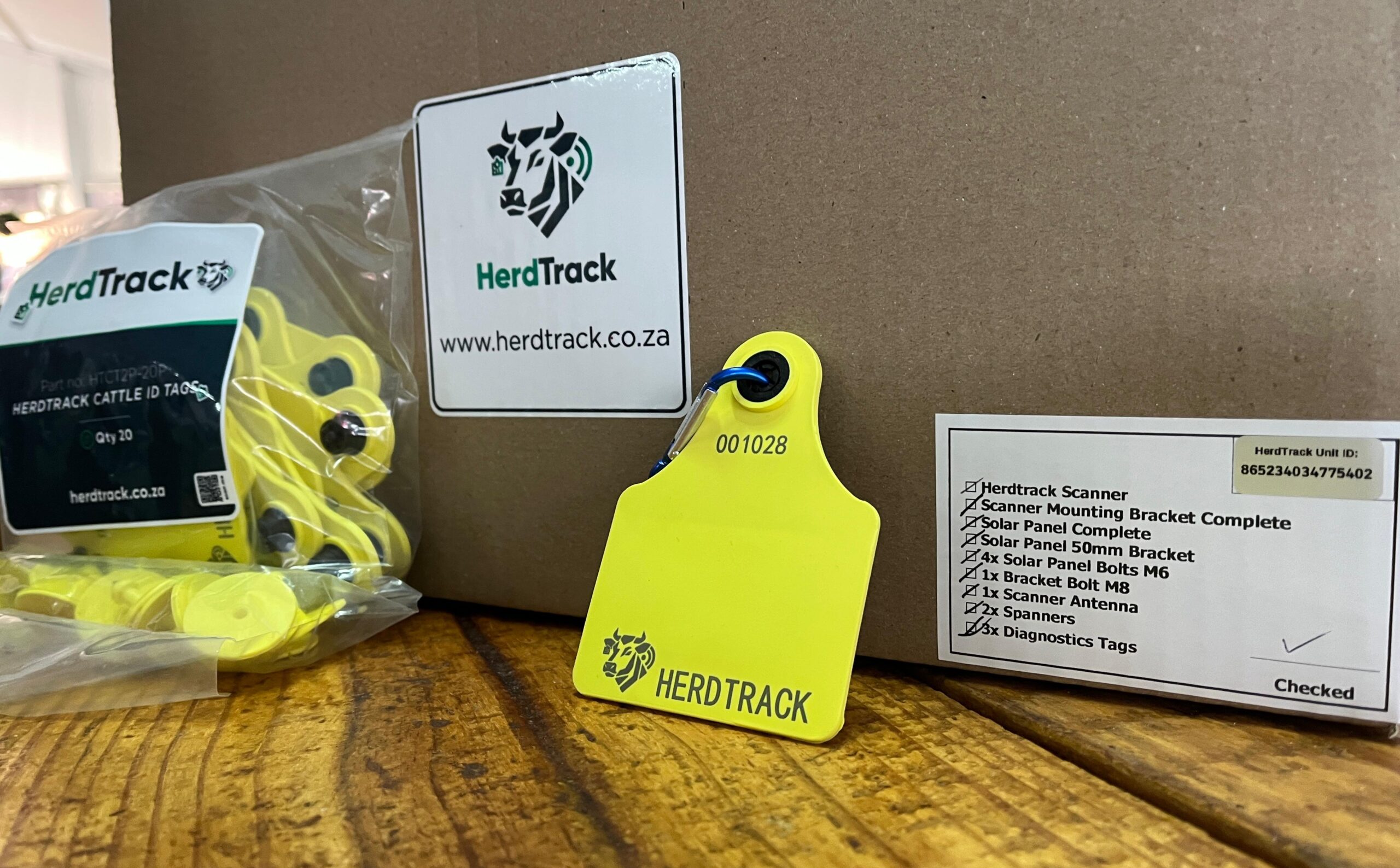
HerdTrack drew a lot of attention at NAMPO and successfully maintained visitor interest by summarising its key selling points: HerdTrack offers ear tags for livestock using long-range RFID scanning technology, making it easier for farmers to monitor herd numbers and animal behaviour. The scanner is powered by a small solar panel, allowing it to be installed anywhere on the farm. A water trough or kraal is ideal, as the scanner transmits data (from livestock units that come to drink or enter the kraal) directly to the HerdTrack cloud-based system. The system can also be used to capture other types of data, making it a valuable tool for improving traceability in the livestock industry.
Although the summary above gives a good overview of HerdTrack, a few frequently asked questions were identified after NAMPO…
How did HerdTrack develop?
Danie Vorster, managing director of CFAM (under which HerdTrack operates as a business unit), experienced challenges on his own farm due to not being able to be there full-time. Frustrations with miscommunicated livestock numbers and behavioural changes going unnoticed led to a clear need for a system like HerdTrack. Practical farming knowledge, combined with strong engineering expertise, resulted in the development of HerdTrack. It was developed by CFAM AgriTech (Pty) Ltd, which forms part of the CFAM group of companies.
What does it cost?
The complete system costs R26,600 excluding VAT. Buyers receive everything needed to set it up in a single box – including the scanner, antenna, solar panel, ear tag applicator, scanner bracket, solar panel bracket (for a 50 mm pole), and spanners. Ear tag prices compare well with standard ear tags: R28 per cattle/game ear tag, and R20 per sheep/goat/pig/small game ear tag. The annual subscription fee (for scanner and software connectivity) is: R3,200 for 1–50 ear tags, or R6,000 for 51–500 ear tags.
How does the app work?
An iOS and Android app will be available in the coming weeks, but in the meantime, farmers can access the system via a web-based platform to view and monitor their data remotely. The system displays real-time data from your livestock, meaning you always have a report on animal numbers and behaviour at hand. Artificial intelligence is integrated to detect changes in an animal’s behavioural patterns. This allows the farmer to be alerted early if a unit shows signs of illness, labour, or theft. HerdTrack works anywhere in the world – it isn’t tied to local networks. Signal reception is necessary, but the scanner detects and uses the strongest available signal in the area. Another common question: Does the farmer cover the cost of connectivity? The answer is no – it’s included in the annual subscription fee.
What value does HerdTrack add to traceability needs?
From the moment a HerdTrack RFID ear tag is inserted, the system enables comprehensive traceability of each animal, enhancing transparency, theft prevention, and biosecurity. Each time the tagged animal passes a scanner, its movement is recorded. When the animal is sold or slaughtered, a full traceability report can be generated, showing its origin and ownership history. Farmers can also input additional animal data into the HerdTrack system – ranging from pregnancy records (and timelines) to medication history and feed inputs. Let’s use weaner calves as an example: At birth, the calf receives a tag. The system logs the date and time each time the tag is scanned by the relevant scanner. The farmer can also input the calf’s weight into the app, which is then stored.
Questions about theft and cloudy weather…
HerdTrack is aware of South Africa’s livestock theft challenges. Some farmers at NAMPO were looking for a GPS-based security system, but HerdTrack is a livestock monitoring and management system using RFID, not GPS tracking. While HerdTrack can assist in detecting unusual behaviour sooner, it was not designed to physically track stolen livestock. The scanner is mounted on a pole and flashes each time a tag is picked up – potentially giving the impression of a surveillance camera, which may deter thieves. The solar panel charges the battery quickly, and the scanner doesn’t use much power when scanning RFID tags. Even in mildly overcast weather, the system typically receives enough solar energy to stay operational. The battery capacity is sufficient to last at least 24 hours without a recharge, provided the herd isn’t excessively large.
More about the ear tags…
The ear tags weigh 17.7 grams (large) and 6.8 grams (small), which is close to the size and weight of standard tags, and there is space for other markings. Farmers can request custom laser engraving (e.g. numbers/abbreviations) on the cattle tags before the RFID chip is inserted. The material used is the same as that of conventional tags, so farmers can also write on them with a marker if they prefer. The unique HerdTrack number printed on each tag can be considered the animal’s “ID number,” linked to the uniquely encoded chip number. If a farmer prefers to keep using their current animal names for records, the system allows the name to be entered separately, with the HerdTrack number acting as the animal’s ID. This format is reflected in the software. Tags are applied using a standard ear tag applicator.
How can HerdTrack help monitor water trough levels?
HerdTrack has developed a simple, practical device that can be placed in water troughs or dams to monitor water levels. The device connects to the HerdTrack scanner and sends a low-water alert via the app when triggered. Farmers can set up distance alerts with a built-in delay before an alarm is activated on their mobile phone – allowing them to monitor water levels remotely.
All the above shows that HerdTrack is a valuable innovation in the livestock industry. What makes it even more valuable is that it’s the first affordable system that enables relatively long-range scanning – and with that, remote livestock monitoring. The questions asked at NAMPO not only confirm HerdTrack’s versatility but also highlight its core purpose: offering practical solutions to everyday farming challenges.
**RFID stands for Radio Frequency Identification.
~ Compiled by René van der Vyver