
The annual NAMPO Harvest Day in Bothaville is the gathering place for South Africa’s agricultural industry and the entire value chain. As the largest and most influential agricultural show in the southern hemisphere, it attracted a record number of 87,191 visitors in 2025.
While the name “National Maize Producers’ Organisation” recalls its roots in the maize triangle, the photos of Angora goats on people’s laps and young boys staring up at massive Chianina bulls are part of the event’s soul. With more than 900 exhibitors on the 40 ha site in 2025, the lowing and bleating of livestock has always been an indispensable part of the experience.
An empty kraal at NAMPO 2026
For 2026, the picture will look drastically different. Grain SA and the NAMPO management made the difficult announcement on 6 February: no split-hoofed animals – including cattle, sheep, goats, and pigs – will be allowed at the 58th show from 12 to 15 May.
This decision stems from the critical risk of foot-and-mouth disease (FMD), which has escalated into a national crisis. During the State of the Nation Address on 12 February, the FMD situation was officially declared a national disaster. It is a threat to the entire agricultural value chain and our international trade status.
The shift to digital traceability
Although the kraals will be empty of animals, the breeders’ societies will still man their stalls. They face the challenge of creating a visitor experience that focuses on animal performance data, genetic advantages, and production value without the animal being physically present. In this new reality, the focus inevitably shifts to technology.
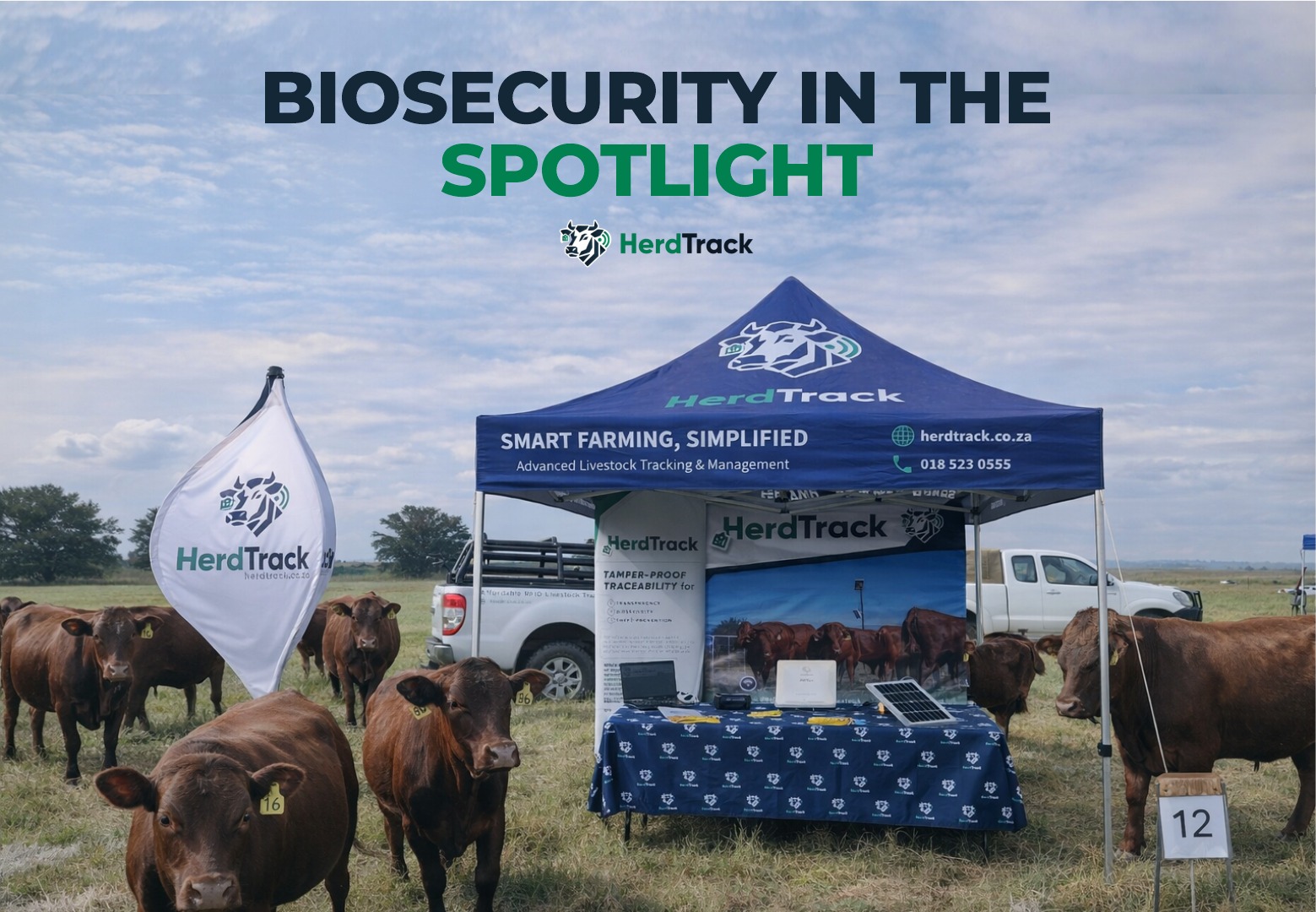
Despite the absence of animals, HerdTrack will be at NAMPO 2026. We expect an increase in enquiries from farmers desperately looking for ways to tighten biosecurity on their farms and lower risks. In a time of quarantine and strict movement control, guesswork is no longer an option.
One of HerdTrack’s strongest advantages lies in traceability. The system enables comprehensive traceability of every livestock unit from the moment the RFID ear tag is inserted. This dramatically improves transparency and biosecurity.
When an animal is tagged, its entire history and movements between different scanning points are recorded. This creates an auditable timeline of where that animal has been. If a farmer wants to sell or slaughter an animal, the system generates detailed ownership and traceability reports that prove its origin. This type of data is worth its weight in gold for peace of mind and regulatory compliance.
A responsible road ahead
We express our full support to the management of NAMPO, Grain SA, and the breeders’ societies for their courageous and difficult decision. It was taken after consultation with various stakeholders to protect the industry in the long term.
And while the traffic – that brings this Free State town to a virtual standstill once a year – will certainly be even more of a challenge this year, we stand firmly behind the decision to put strict biosecurity measures in place at the entrance. It is essential that every vehicle and any equipment involved in animal-related activities is thoroughly sprayed down and disinfected.
To the livestock farmers currently bowed under the emotional and financial pressure of the FMD storm: we stand with you. The road ahead might be without animals at the show for now, but it is not without hope or solutions. HerdTrack is ready to inform farmers at NAMPO about how our practical system can help secure your herd for the future.
~ Compiled by René van der Vyver